Homemade Sensors, Open Data, and One Very Persistent Undergrad: How Student Labs Are Feeding America's Disaster Research
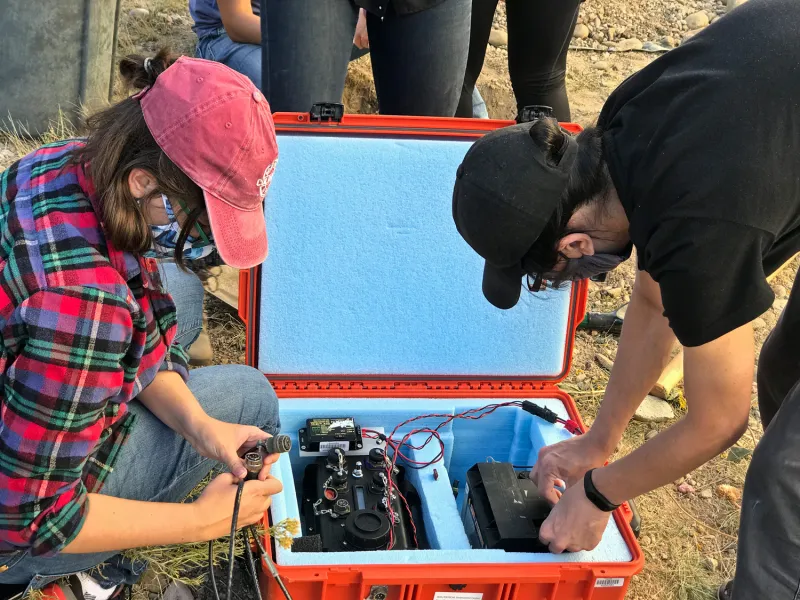
Photo: student assembling low-cost seismometer sensor electronics workshop, via coloradogeologicalsurvey.org
The email arrived at 2 a.m. local time, which Bayu later learned was unremarkable for the sender: a research scientist with the U.S. Geological Survey's earthquake hazards program, writing to ask whether the rupture-model figures in a recent preprint were available for reuse. The preprint's lead author was a 22-year-old geophysics senior in Bandung who had never set foot in the United States.
Bayu's project began the way a lot of consequential student research does — with a question nobody stopped to ask him. Indonesia sits on some of the most seismically active real estate on the planet, yet the dense networks of monitoring stations that blanket California and Japan remain, in much of the archipelago, sparse. So he started building his own.
The $40 Seismometer
The hardware revolution at the center of this story is almost embarrassingly cheap. Open-source designs for MEMS-based seismometers — the same sensor family found in a smartphone's accelerometer — can be assembled for roughly the cost of a textbook. Bayu's stations, distributed to classmates and relatives across West Java, log ground motion continuously and upload to a shared server. His network is not a replacement for institutional monitoring, and he is careful to say so. But as a dense, low-cost complement for aftershock characterization and site-response studies, it has proven genuinely useful.
Useful enough that his co-authored analysis of shallow crustal attenuation, posted as a preprint with two faculty collaborators, has been cited in hazard assessments by researchers at FEMA-affiliated institutions and in a Pacific Northwest seismic safety report.
Flood Maps From a Dorm Room
Two time zones away in Yogyakarta, a different kind of student science is underway. Salsabila, an environmental engineering junior, spends her evenings refining hydraulic flood models of the Code River watershed using nothing more exotic than open satellite imagery, publicly released elevation data, and a gaming laptop bought secondhand. Her validation work — comparing modeled inundation extents against crowd-sourced flood reports from the December 2023 event — drew attention from a hazard-mitigation research group in Louisiana, for whom pluvial flooding is, as she puts it, "a shared language."
Her modeling pipeline is now documented in a public repository, and her methods write-up has been downloaded more times in the American South than in Indonesia. The irony does not escape her.
Why It Works Now
Ask the students what changed, and they give a consistent answer: not funding, not equipment, but access. Free seismic catalogs from international agencies. Copernicus and Landsat imagery at no cost. Python libraries that once required institutional licenses. The technical literature, increasingly, is open. What remains scarce is mentorship and legitimacy — the sense that an undergraduate's independent project deserves serious attention.
That is where American collaborators have played an unexpected role. A handful of US-based researchers, encountering student preprints through repositories and academic social media, have begun reviewing, commenting, and occasionally co-authoring. The dynamic inverts the traditional flow of scientific mentorship: instead of expertise moving from the Global North outward, curiosity and data are moving toward it.
The Caveats Worth Keeping
Enthusiasm should be tempered with rigor. Volunteer-run sensor networks carry calibration uncertainties; student flood models rest on elevation data with known error margins. The most responsible student researchers — and the American scientists who engage with them — emphasize these limitations explicitly. The point is not that a dorm-room lab replaces a national survey. It is that the boundary between "student project" and "real science" has become far more porous than either campuses or agencies assumed.
Bayu is now applying to graduate programs in Seattle and Berkeley. Salsabila is expanding her model to two more watersheds. Neither describes the work as extraordinary. "The data was just sitting there," Bayu says. "Somebody had to look at it."
Somebody did. And a growing file of citations says the somebody was an undergraduate with a soldering iron, a laptop, and the stubbornness to keep looking.