The Quiet Revolution in Campus Libraries: How Indonesia's Undergraduates Are Going Global
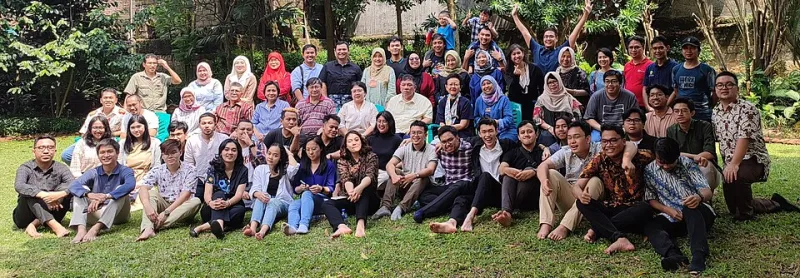
Photo: Jeromi Mikhael, CC0, via Wikimedia Commons
Ask an American college student where groundbreaking undergraduate research happens, and the answers come quickly: MIT, Stanford, the Ivy League. What rarely makes the list is Universitas Indonesia in Depok, or Gadjah Mada in Yogyakarta, or any of the more than 3,000 higher education institutions scattered across the Indonesian archipelago.
That assumption is overdue for a correction.
A Publishing Landscape Built Against Them
The obstacles facing an Indonesian undergraduate who wants to publish are, by American standards, staggering. A single subscription to a major commercial journal can cost more than a semester's tuition. Federal research funding per student is a fraction of what even mid-tier US universities provide. And then there is language: nearly all high-impact journals publish in English, while most Indonesian students complete their education in Bahasa Indonesia.
For decades, these barriers meant that much of the country's best student scholarship simply disappeared — filed away as graduation requirements, read by a thesis committee, and never seen again.
The Open Access Turnaround
What changed was the internet, and more specifically, the open access movement that American universities helped pioneer. Platforms like DOAJ (the Directory of Open Access Journals), OJS-based university journals, and local academic repositories have given Indonesian students something previous generations never had: a direct pipeline to a global readership.
University-run journals now publish tens of thousands of student papers annually, many indexed internationally. A civil engineering student in Surabaya can watch her earthquake-resilient housing study get cited by a researcher at a Texas A&M lab. A public health undergraduate in Makassar can see his dengue mapping model picked up by policymakers an ocean away.
The economics matter here, too. Open publishing removes the page fees that make traditional journals prohibitive, and English-language editing — once an expensive luxury — is increasingly handled through peer mentoring networks and campus writing centers modeled loosely on American university writing programs.
Creative Workarounds Worth Copying
Indonesian students have developed strategies that would resonate with any cash-strapped grad student in the United States:
- Preprint culture. Rather than waiting months for peer review, students post early versions on repositories like SSRN and institutional archives, building citation momentum before formal publication.
- Collaborative translation. Student-run editing collectives trade English polishing across departments — a biology major proofreads an economics paper, and vice versa.
- Conference-first publishing. Regional and international student conferences, many with lower fees than journal submissions, serve as accessible entry points.
- Faculty co-authorship. Supervisors increasingly lend institutional credibility, mirroring the mentorship model familiar at US research universities.
Why American Readers Should Care
There is a practical reason to pay attention. Indonesia sits at the intersection of some of the century's defining challenges: biodiversity loss, tropical disease, deforestation, seismic risk, and the future of global food supply. The students documenting these problems firsthand are producing data that no American lab can replicate.
There is also an equity argument. The open access movement gained momentum in the US partly because of paywalls blocking research that public money funded. Indonesian students — publishing from campuses with a fraction of the resources — are proving that open infrastructure can democratize science at a scale American advocates have long promised.
The lesson travels well. If a twenty-one-year-old in Yogyakarta can put peer-reviewed research in front of a reader in Chicago with nothing but a laptop and an open access platform, the excuse that serious scholarship requires elite institutional backing grows thinner by the day.
The revolution, in other words, is not coming from the top of the academic hierarchy. It is being uploaded from the bottom — one undergraduate paper at a time.