Mangroves, Rice, and Rainforest Remedies: Five Student Studies With Global Stakes
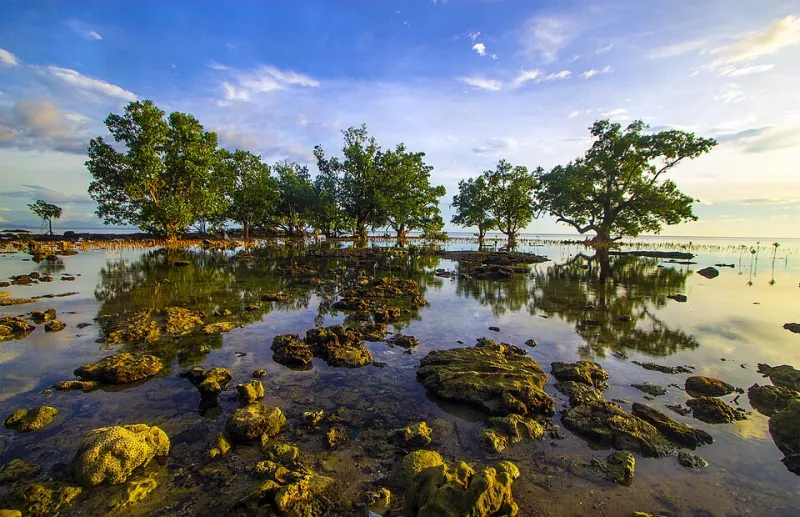
Photo: RanieljoseMCastaneda, CC BY 4.0, via Wikimedia Commons
Some of the most consequential environmental and medical research happening right now is being produced by undergraduates working with modest equipment and extraordinary field conditions. Indonesia — the world's largest archipelago, a top rice producer, and home to some of Earth's richest biodiversity — is an ideal vantage point. Below are five student-led studies that deserve a spot on your reading list, translated into plain English.
1. Counting What Mangroves Store — and What We Lose When They're Gone
Students at coastal Java universities have been quantifying carbon storage in restored mangrove forests, comparing young replanted stands with old-growth zones. Their field measurements found that even relatively young mangroves begin locking away significant carbon within their first decade — and that degraded sites store dramatically less.
Why it matters in the US: Coastal restoration debates from Louisiana to the Chesapeake Bay hinge on the same question: does replanting actually pay off? This work adds hard data supporting early and aggressive restoration.
2. Rice Paddy Water Tricks That Cut Emissions
A team of agriculture students examined alternate wetting and drying — a water management technique where paddies are deliberately drained mid-season instead of kept permanently flooded. Their trials showed meaningful reductions in methane output with only minor effects on harvest size.
Why it matters in the US: Rice cultivation is a major methane source globally, and American growers in Arkansas and California face mounting pressure to cut emissions. Simple water scheduling — no new equipment required — is exactly the kind of low-cost fix farmers want.
3. Herbal Pharmacology Gets a Lab Bench Check
Indonesian traditional medicine (jamu) has long been dismissed or romanticized in equal measure. Undergraduate pharmacology students have been doing the unglamorous work of testing local plant extracts against bacterial cultures, documenting which compounds show genuine antimicrobial activity and at what concentrations.
Why it matters in the US: With antibiotic resistance flagged as a top-tier public health threat, researchers everywhere are screening traditional remedies for lead compounds. Rigorous student work like this helps separate folk wisdom from actual pharmacology.
4. Mapping Flood Risk With Open Satellite Data
Civil engineering and geography students have been combining free satellite imagery with local survey data to map urban flood vulnerability in rapidly growing cities. Their models identified neighborhoods where informal development has quietly placed thousands of residents in high-risk zones.
Why it matters in the US: American cities from Houston to Miami wrestle with outdated flood maps. Demonstrating that students can build useful risk models using entirely open data is a template any American municipal planning office could follow.
5. Seaweed as a Small-Fisheries Lifeline
Fisheries science students documented how coastal communities shifting from wild-capture fishing to seaweed farming saw steadier incomes and reduced pressure on depleted reef fish stocks.
Why it matters in the US: Aquaculture is one of the fastest-growing food sectors in North America, and seaweed farming is gaining a foothold in Maine and Alaska. Evidence from the world's largest seaweed-producing nation offers a preview of what works — and what doesn't.
The Bigger Picture
None of these papers arrived wrapped in press releases or backed by seven-figure grants. They emerged from fieldwork, spreadsheets, and open access publishing — the same infrastructure any American undergraduate can tap. That is precisely the point: breakthrough science is not the exclusive property of well-funded labs. It is a global, student-powered effort, and the archipelago is doing its part.